Posted on: 24/09/2025
in
This content is located in CAPS under Network Technologies: Networks for Grade 11.
Understanding the topology of Local Area Networks (LANs) is essential for grasping how data flows within networks. This blog focuses on the different types of LAN topologies—Star, Ring, Bus, Point-to-Point, Mesh, Tree, and Hybrid. These structures not only form the backbone of modern networks but also influence network performance, reliability, and scalability.
Practical Classroom Ideas for Teaching LAN Topologies
Star Topology
A Star topology connects all nodes to a central hub or switch. It’s a great entry point because it is common in schools and offices.
- Activity: Simulate a Star topology using a rope as the central hub and smaller strings as connections to individual students representing computers. Each student can pass a message to the central hub, which redirects it to another student.
- Materials: Use items like a paper plate (hub) and strings (cables). Label each end with stickers indicating “Sender” and “Receiver.”
- Discussion: Discuss how the central hub is a single point of failure and its impact on the network if it malfunctions.
Ring Topology
In a Ring topology, each node connects to two others, forming a circular data path.
- Activity: Arrange students in a circle and use a ball to represent data. The ball must pass from one student to the next without skipping any nodes.
- Materials: A ball or rolled-up paper to simulate data packets.
- Critical Thinking: Discuss latency and the impact of a broken connection on data flow.
Bus Topology
This topology features a single backbone cable to which all nodes are connected.
- Activity: Lay out a long rope on the floor and attach shorter ropes representing devices. Show how data must travel along the main cable.
- Materials: A long rope and tape to secure smaller ropes representing connections.
- Extension: Discuss data collisions and how terminators are used to prevent signal loss.
Point-to-Point Topology
This simple topology connects two devices directly.
- Activity: Use two students with string connecting them to simulate direct communication. Explore scenarios like sending private messages.
- Materials: Short pieces of string and cards with written messages.
- Real-World Link: Discuss how Point-to-Point is used in home networks for printer and computer communication.
Mesh Topology
In a Mesh topology, every node connects directly to every other node.
- Activity: Create a web using string to connect all students, illustrating direct communication paths.
- Materials: String to connect students (nodes).
- Challenge: Have students simulate data delivery using multiple paths to show redundancy.
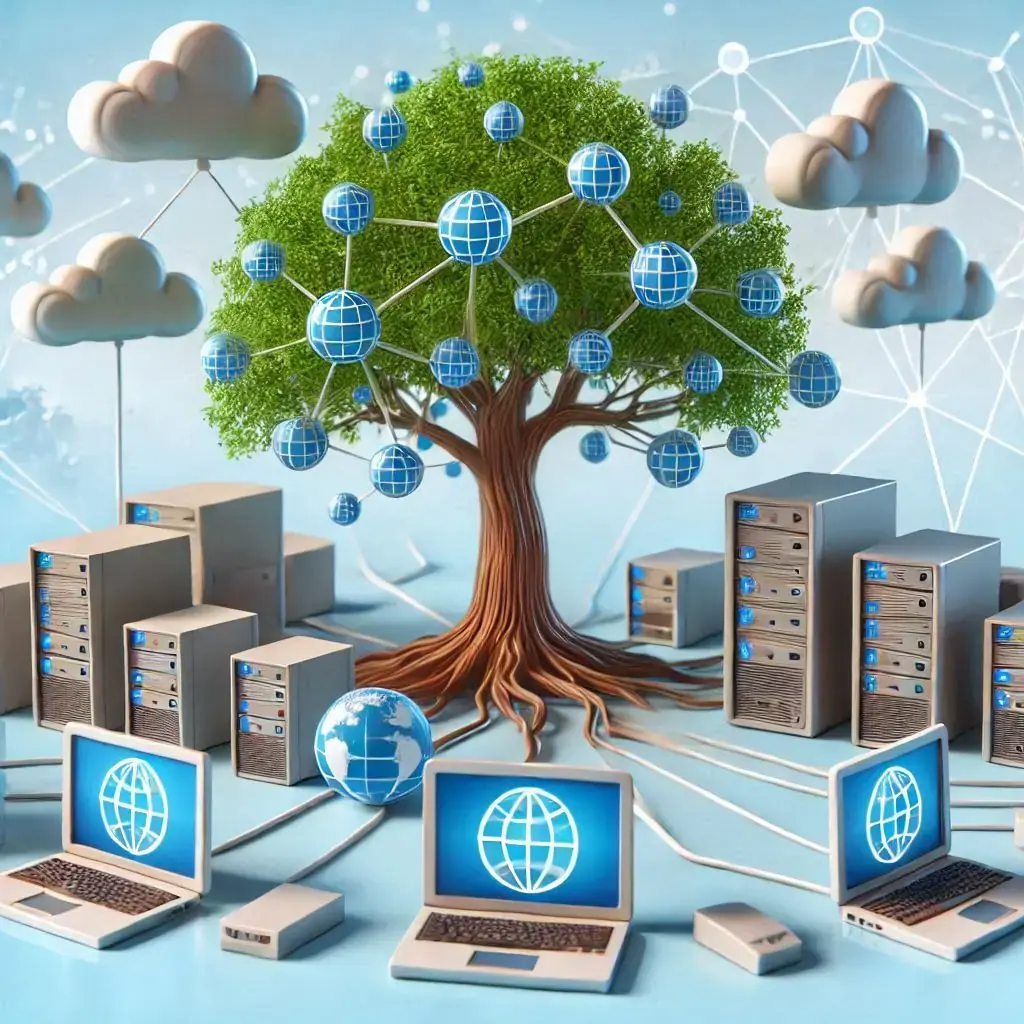
Tree Topology
This hierarchical topology branches out like a tree.
- Activity: Use a flowchart to represent a Tree topology. Assign roles: one “root,” several “branches,” and “leaves” representing devices.
- Materials: Paper and markers for drawing a topology tree on the board.
- Insight: Explore how Tree topologies combine Star and Bus topologies to provide scalability.
Hybrid Topology
Hybrid topologies combine two or more types of topologies.
- Activity: Design a hybrid network on paper. Mix Star and Ring topologies in the design and justify the choice.
- Materials: Graph paper and coloured pens for drawing.
- Creative Thinking: Ask students how hybrid networks can optimise performance in a school network.
Adapting for Resource-Limited Classrooms
In schools with limited resources, these activities can be done using low-cost materials like string, paper, and simple role-play. For digital simulation, free online tools like Cisco Packet Tracer can help visualise network topologies.
Understanding LAN topologies enables students to grasp the structure and functionality of networks. These practical activities not only demystify theoretical concepts but also encourage problem-solving and collaboration.